
Warehouse rodent proofing checklist for Sri Lankan operators
A practical warehouse rodent control checklist for Sri Lankan logistics and storage facilities that need proofing, monitoring, and better pest visibility.
Why warehouses need more than reactive rodent control
Warehouses often discover rodent activity after damage is already visible. Droppings appear near lower racks. Packaging shows gnawing. Staff hear movement near roller shutters or in roof voids. Someone places ad-hoc bait, and the site feels quieter for a short time. But unless the warehouse understands how rodents are entering, what keeps them active, and how monitoring is being recorded, the same problem usually comes back.
Sri Lankan warehouse environments often face extra pressure because of monsoon-driven movement, agricultural transport links, irregular waste discipline, and long product dwell time in warm zones. A rodent control plan for this environment has to combine proofing, monitoring, sanitation, and treatment. It cannot rely on product placement alone.
Start with visibility, not assumptions
The first question is simple: where is activity strongest, and how do we know? Good visibility comes from mapped monitoring points, staff reporting habits, and better inspection access around walls, pallets, drains, and loading zones. If pallets are stacked tight against walls, if damaged product stays too long in one corner, or if refuse handling is inconsistent, you are likely making inspection harder and rodent activity easier.
At PestControl.lk rodent control, we usually start by reviewing how the site is laid out and where rodents are most likely to travel. Roller door gaps, damaged mesh, service penetrations, cluttered plant areas, and external waste points all matter. So do the habits of the operation. When waste removal is delayed, stock arrives with residue, or outdoor grass grows close to the wall line, the warehouse starts supporting repeat pressure.
The core proofing checklist
Inspect door sweeps and dock seals. Check for pipe gaps, cable penetrations, broken vents, and roofline access. Review whether drains or service trenches create hidden pathways. Trim vegetation that touches the building. Remove disused materials from perimeter zones. If the warehouse includes staff food areas, treat them with the same discipline as the main stock zone.
Inside the warehouse, review pallet spacing, damaged inventory segregation, spill handling, and housekeeping around lower racks. Stock should not sit indefinitely in forgotten corners. Inspection lanes need to stay visible. Teams should know that a single sighting is worth recording, especially after rain or when receiving high-risk goods.
Monitoring and reporting matter for audits
If the warehouse serves food, retail, healthcare, or export-linked operations, trend visibility matters almost as much as immediate control. You need to know whether rodent pressure is stable, rising, or shifting from one zone to another. That is where mapped stations, service notes, and recurring review become useful. Monitoring does not just prove that a vendor visited. It helps site management see where operations are creating fresh risk.
Treatment still has a place
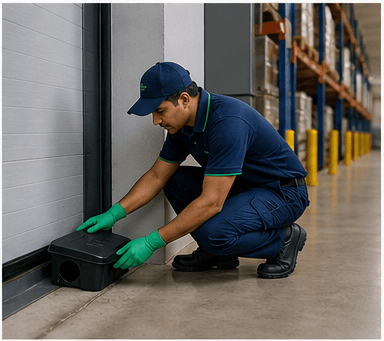
Proofing and sanitation are essential, but treatment still matters when active pressure exists. The point is that treatment should be secure, strategic, and reviewable. Tamper-resistant stations, planned placement, and clear servicing intervals are better than scattered improvisation. In higher-risk environments, mechanical trapping or special zoning may also be relevant depending on the operation.
The best warehouse habit
The best long-term habit is making rodent control part of the facility routine instead of a panic reaction. Walk the site after rain. Review external edges. Track sightings by location. Correct gaps quickly. Make waste and damaged stock handling consistent. And when the site grows, update the pest plan instead of assuming the old layout still makes sense.
Rodent control is strongest when the warehouse becomes harder to enter, harder to hide in, and easier to inspect.